 Matter Due
Immigration practices face a particular mix: many matters per caseworker, clients whose status can depend on a date, and statutory windows measured in days rather than months. Add caseworkers working across several offices and a reception full of clients, and keeping every date visible becomes its own job.
This guide covers the dates most immigration teams need to track, what makes them different, and how to set reminders, escalation and visibility around them. It is not immigration advice. Always confirm the time limit that applies from the decision, the rules and any directions on the matter.
The dates an immigration team needs to track
Appeal windows to the First-tier Tribunal
GOV.UK's guidance on
appealing to the
First-tier Tribunal (Immigration and Asylum Chamber) sets out the basic windows. If the appellant is
in the UK, You have 14 days from the date you received the decision letter to submit your appeal.
If they are outside the UK, it is 28 days from receiving the decision letter. Where the decision requires
them to leave the UK first, it is 28 days from the date they left. An appeal submitted late must explain
why, and the tribunal will then decide if it can still hear your appeal.
Two practical points follow. First, the window often runs from receipt of the decision, so the date of receipt needs recording as carefully as the decision date. Second, fourteen days leaves little room. A reminder schedule designed for a court filing weeks away is the wrong shape.
Home Office requests and appointments
Requests for further information or evidence usually carry their own deadline in the letter. Biometric appointments, interviews and document deadlines all need an owner and a reminder. They are easy to lose because they arrive by email in the middle of other correspondence.
Tribunal directions and hearings
Once an appeal is under way, directions set dates for bundles, skeleton arguments and evidence, and hearings need interpreters, witnesses and counsel arranged in good time. Each direction is a deadline in its own right, and directions can be varied, so the record must be updated when they change.
Clients' leave expiry dates
A client's current permission end date is often the most important date on the file. Whether an application is made in time can have serious consequences for the client's position, so many firms track expiry dates from the first instruction and plan backwards from them.
What makes immigration deadlines hard to manage
- Short windows. A 14-day window can be lost to one week of annual leave plus a busy week.
- Volume. A caseworker with dozens of live matters cannot hold every date in their head, and a supervisor cannot open every file each week.
- Dates that start from an event. “From receipt” means the clock may already be running when the letter reaches the right person.
- Client confidentiality in a shared office. A deadline list on a wall is useful, but not if clients waiting in reception can read names on it.
Reminder schedules for short windows
The common default of 14, 7 and 1 day before suits many litigation deadlines. For an appeal window that is itself only 14 days long, it is the wrong shape: the first reminder would fire before the window exists. Better patterns for short windows:
| Date | Example reminder points |
|---|---|
| In-country appeal deadline (14 days) | 7 days, 3 days and 1 day before, and on the morning |
| Home Office request deadline | Depends on the window. Leave time to collect evidence from the client |
| Tribunal hearing | 21, 14, 7, 3 and 1 days before (bundles, interpreter, counsel) |
| Client's leave expiry | Months ahead, to give the client time to gather documents, then closer points |
These are illustrations to adapt, not recommendations for any particular matter. The principle is the same throughout: the reminder schedule should match the time the work needs, not a firm-wide habit.
Supervision in immigration work
The SRA's immigration
work guidance describes supervisors having clear oversight of work being done while it is live, at
all key stages
and some knowledge of each matter being progressed by the person doing the work.
Its effective
supervision guidance adds that for high-risk or complex work the supervisor might need to have some
awareness of every file.
Deadlines are the most practical way to give that oversight at volume. A supervisor who sees every overdue and at-risk deadline across the team, and is told automatically when one passes, has live oversight of key stages without opening every file. Our guide to supervising deadlines under the SRA guidance sets out a weekly routine.
Keeping deadlines visible without exposing clients
Many immigration teams work in open-plan offices with clients nearby. A shared screen showing the week's deadlines helps everyone see the pressure points, but it must not show client details to visitors. The answer is to control what each screen shows: a caseworkers' room screen can show full detail, while a screen visible from reception shows only matter references and dates, or less.
Matter Due lets each deadline carry its own reminder schedule, set in days, hours and minutes, so a 14-day appeal window and a hearing two months away are reminded differently. Reminders reach caseworkers by email, SMS or WhatsApp. A supervisor is told automatically when a deadline is still open once it is overdue. Each office screen can be set to Full, Standard or Private detail, and a screen in Private mode never receives client names. Reminders only ever go to your staff, never to clients.
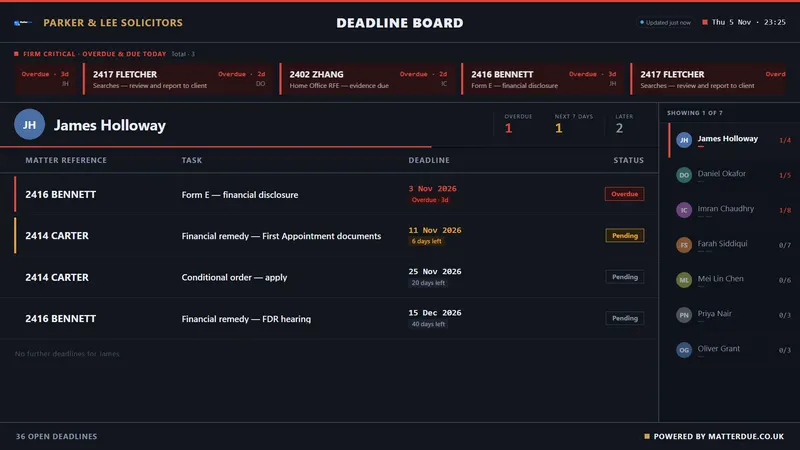
The office deadline board in Matter Due (fictional demo firm, Full detail mode).
Questions firms ask
How long do you have to appeal an immigration decision to the First-tier Tribunal?
According to GOV.UK, 14 days from receiving the decision letter if the appellant is in the UK, and 28 days if they are outside the UK (or 28 days from leaving, where they had to leave first). Late appeals must explain the delay. Always check the decision letter and the current rules for the specific case.
Should clients get deadline reminders too?
That is a matter for your client care process. Matter Due deliberately reminds only your own staff. Clients are never contacted by it.
We already record dates in our case-management system. Is that enough?
It may be, if everyone uses it consistently and supervisors can see across the team. If not, see deadline control alongside your case-management system.
Sources
- GOV.UK, Appeal against a visa or immigration decision.
- SRA, Immigration work guidance.
- SRA, Effective supervision guidance, updated 12 June 2026.
This guide is general information for law-firm managers, not legal or regulatory advice. Check time limits against the rules and directions that apply to each matter. Last reviewed .