 Matter Due
Supervision is a live topic. The SRA updated its effective supervision guidance on 12 June 2026 (it was first published in November 2022). For partners, COLPs and practice managers, deadlines are a practical place to start. They are concrete, they carry real risk, and whether one was handled on time is a matter of record.
This guide pulls together what the SRA's Code and guidance say that bears on deadlines, and suggests a light-touch way to supervise key dates in a small firm. It is not regulatory advice. Read the guidance itself and apply it to your own firm.
What the Code for Firms requires
Three paragraphs of the SRA Code of Conduct for Firms are the backdrop:
- 2.1: firms must have
effective governance structures, arrangements, systems and controls
to ensure they and their people comply with the SRA's requirements. - 2.5:
You identify, monitor and manage all material risks to your business
. - 4.4:
You have an effective system for supervising clients' matters.
None of these mentions deadlines by name. But a missed limitation date or court deadline is about as material a risk as most small firms face, and supervising client matters naturally includes knowing whether their key dates are being met.
What the effective supervision guidance says
Several points in the guidance translate directly into how a firm handles deadlines:
- For people being supervised, the guidance says:
Flag issues to your supervisor in good time ahead of deadlines and make it clear if a matter is urgent or important.
- On evidence:
Firms should be able to evidence the supervision arrangements they choose for each area of work
, and supervisionshould be evidenced, for example by emails, file notes and time records.
- On risk:
Where work is high risk and/or complex the supervisor might need to have some awareness of every file.
- On management information, firms should, where viable, extract and review management information to understand what is happening in the business.
For immigration work, the SRA's separate
immigration work
guidance describes supervisors having clear oversight of work being done while it is live, at all key
stages.
Our guide to deadline management for
immigration firms covers that area in more detail.
Where deadline supervision usually breaks down
In a small firm, supervision of deadlines often relies on two things: the fee earner raising problems, and the supervisor asking. Both are human, and both fail under pressure. The common gaps are:
- No single view. The supervisor can only see deadlines by opening each file or asking each person.
- Problems surface late. A fee earner who is struggling is the person least likely to flag it early.
- No evidence trail. Supervision happened in corridor conversations, which leaves little to show afterwards.
- All-or-nothing oversight. Either the supervisor checks everything, which does not scale, or relies on trust, which does not show anything.
A practical model: supervise by exception
The aim is to put the supervisor's attention where the risk is, and leave a record that it was there. A simple model has four parts.
1. Give supervisors a firm-wide deadline view
A supervisor should be able to see, without asking anyone, how many deadlines are overdue, due this week and at risk, and drill into any person's list. This is the management information the guidance refers to, applied to deadlines.
2. Make escalation automatic
The guidance asks supervisees to flag issues in good time. A rule-based escalation does that even when the person does not. For example: any key date still open once it is overdue goes to the supervisor automatically. For high-risk work, consider escalating a set period before the date if the work is not yet marked complete.
3. Match the level of oversight to the risk
Not every deadline needs a partner's eyes. Decide which matter types or deadline types are high risk (limitation dates, tribunal appeals, hearings) and give those earlier reminders, earlier escalation and a place in the weekly review. Routine dates can run on the default schedule.
4. Keep the record as you go
The best evidence is the record the work itself leaves: when each reminder went out, to whom, and who marked the deadline complete and when. Being able to export that history to a spreadsheet gives you something concrete for a file review, an audit or a regulator's question.
A weekly routine for supervising deadlines
- Monday: the supervisor reviews the firm view: anything overdue, anything at risk, anyone with an unusually heavy week.
- During the week: escalations arrive automatically. Each gets a short note of what was done.
- Friday: a quick look at what was completed late, and why.
- Monthly: export the reminder and completion history, review patterns by person and matter type, and keep the export with your supervision records.
This takes minutes rather than hours. It is also proportionate: the supervisor spends time on exceptions, not on re-checking work that is on track.
Matter Due gives supervisors the firm-wide view (active, due this week, overdue and at risk, filterable by caseworker). It escalates automatically when a deadline is still open once it is overdue, or at a lead time you set. It keeps a record of every reminder and completion that you can download as a spreadsheet. Staff roles control who sees reports and settings.
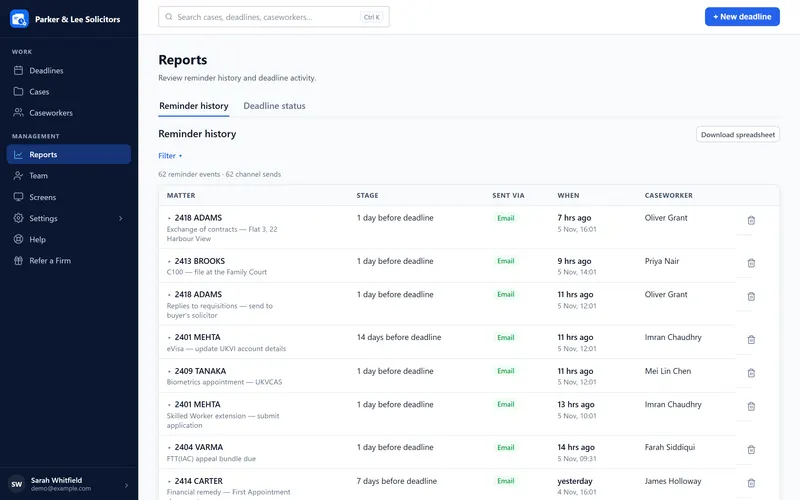
Reminder history in Matter Due, ready to download as a spreadsheet (fictional demo firm).
Questions firms ask
Does the SRA require deadline software?
No. The SRA does not prescribe tools. It requires effective systems for supervision and for managing risk, and expects firms to be able to evidence their supervision arrangements. How you meet that is up to the firm.
What counts as evidence of supervision?
The guidance gives examples such as emails, file notes and time records. For deadlines, a record of reminders, escalations and completions, together with notes of what the supervisor did about exceptions, is practical evidence that the system operates.
Isn't automatic escalation a sign of distrust?
It works the other way. A rule that applies to everyone removes the awkwardness of chasing individuals, and it protects fee earners as much as clients: no one is left alone with a deadline they cannot meet.
Sources
- SRA, Effective supervision guidance, updated 12 June 2026.
- SRA, Code of Conduct for Firms, paragraphs 2.1, 2.5 and 4.4.
- SRA, Immigration work guidance.
This guide is general information for law-firm managers, not legal or regulatory advice. Check time limits against the rules and directions that apply to each matter. Last reviewed .