 Matter Due
Every firm has a diary. Most have reminders of some kind. And yet missing a time limit remains one of the
best-known ways for a solicitor to end up facing a claim. The Law Society Gazette put it bluntly in a
risk-management piece more than twenty years ago: Missed time limits are still a major source of claims
against solicitors
, and Good diary systems are not enough
. The same piece warned that diaries and
reminders will be ineffective if the information fed into them is inaccurate
.
That last point is the heart of it. A key dates system is not a piece of software or a diary. It is the whole chain from the moment a date arises to the moment someone confirms the work is done. This guide breaks that chain into six parts and shows where each one usually fails in a small firm.
What is at stake
Some deadlines can be fixed with an application and an apology. Others cannot. The obvious example is limitation. Under the Limitation Act 1980, the general periods include six years for actions in tort (section 2) and simple contract (section 5), and three years for personal injury claims (section 11). There are important exceptions and variations, so the right date for a particular matter always needs working out by a qualified person. But once a limitation date has passed, the client's position can be lost for good.
Court and tribunal deadlines carry their own risks: costs, sanctions, applications for relief, and the damage to the client relationship. The practical aim is the same for all of them: no key date should depend on a single person remembering it.
How deadlines actually get missed
When firms look back at a near miss, the cause is usually one of these:
- Never recorded. The date was in a letter or court order that was read, filed and not put in the diary.
- Recorded wrongly. A miscalculation: counting from the wrong day, forgetting how weekends and bank holidays are treated, or typing the wrong month.
- Owner changed. The fee earner went on leave, left the firm or handed the matter on, and the date did not move with the work.
- Reminder lost in the noise. An alert arrived, but among dozens of others, and was dismissed.
- Date changed, record didn't. Directions were varied or a hearing was relisted, and the old date stayed in the system.
- Everyone thought someone else had it. Two people worked on the matter and each assumed the other was dealing with the deadline.
None of these is solved by “try harder”. Each needs a step in the process.
The six parts of a key dates system
1. Capture: record the date when it arises
Set a firm rule that a key date is recorded the same day the document creating it is received, by the person who opens it. Build it into how post and email are handled. Add a key dates check to matter opening, so limitation and other early dates are captured before work starts.
2. Check: have a second person confirm the calculation
Dates are often calculated under rules that are easy to misapply. The Civil Procedure Rules are a good example. Under CPR rule 2.8, periods expressed in days are counted as “clear days”, and where a period is five days or less, weekends and bank holidays do not count. For high-stakes dates such as limitation, have a second person check the date and record who checked it.
3. Own: one named person, plus cover
Every key date needs exactly one owner. “The team” is not an owner. Decide who covers when the owner is away, and make reassignment part of your leaving and holiday handover checklists. A useful test: could a manager tell you, right now, who owns every deadline due in the next fortnight?
4. Remind: more than one chance to notice
One reminder on the day is not a system. Use layered reminders that give enough lead time to prepare, not just to panic. A common starting point is 14, 7 and 1 day before. High-stakes dates often deserve earlier and more frequent points. Short windows, such as a tribunal appeal window measured in days, need reminders measured in days or hours. The table below is a starting point to adapt, not a rule.
| Type of date | Example reminder points | Why |
|---|---|---|
| Limitation date | Months ahead, then weekly in the final month | Issuing a claim takes preparation, and the cost of a miss is highest. |
| Court filing or service deadline | 14, 7 and 1 day before | Time to draft, approve and file. |
| Hearing | 21, 14, 7, 3 and 1 days before | Bundles, witnesses, counsel and interpreters all need lead time. |
| Short statutory window (days) | A few days before, the day before, and on the morning | The whole window is short, so later points matter more. |
Send reminders to the channel people actually read. For some teams that is email. For people out at court or visiting clients, a text message is harder to miss.
5. Escalate: decide when a supervisor is told
The step most often missing in small firms is escalation. Agree, in writing, when a deadline is escalated and to whom. For example: “Any key date still open once it is overdue goes to the supervising partner.” Firms handling higher-risk work may want escalation before the date, such as a set number of days ahead for anything not yet marked complete. Escalation should be automatic and rule-based, so it does not feel personal.
6. Close: record who completed it, and when
A deadline is not done until it is marked done, with a name and a time. This closes the loop for reminders, gives managers an accurate picture, and leaves a record if anyone later asks how the matter was handled.
A ten-minute weekly key dates review
Even with good software, a short weekly review catches what systems cannot. Keep it tight:
- Anything overdue: why, and what happens today?
- Everything due in the next 14 days: is the owner on track and in the office?
- Anyone on leave next week: who covers their dates?
- New matters opened this week: have their key dates been captured and checked?
A shared screen showing the firm's deadlines makes this meeting faster, because everyone looks at the same list rather than their own diary.
Central diary or personal diaries?
Both. Personal calendars are where people plan their day, so key dates should appear there. But the
Gazette's example of good practice was a firm with a central back-up diary which generated reminders of
key dates
: a firm-level record that does not depend on any one person's calendar. The central record
is the one managers supervise from and the one that survives someone leaving.
Matter Due covers parts 3 to 6 for the whole firm. Each deadline has a named owner. Reminders go out automatically on a schedule your firm sets once, and a single deadline can have its own schedule. A manager is told when a deadline is still open once it is overdue, or earlier if you choose. Completion is recorded with a name and time. Capture and checking stay with your people, where they belong.
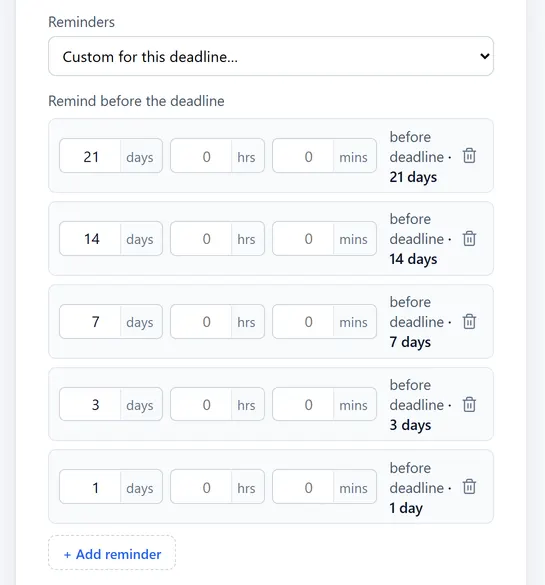
A hearing given its own reminder schedule in Matter Due (fictional demo firm).
Questions firms ask
What is a key dates system in a law firm?
It is the firm's process for recording, checking, assigning, reminding, escalating and closing the dates that matter on each matter, such as limitation dates, court and tribunal deadlines and hearings. It can run on paper, a spreadsheet, a case-management system or dedicated software. The process matters more than the tool.
How far ahead should reminders go out?
Far enough ahead to prepare the work, not just to notice the date. Many firms start with 14, 7 and 1 day before, and give high-stakes or complex dates earlier and more frequent reminders. Short windows need reminders in days or hours.
Who should be told when a deadline is missed?
The owner's supervisor, automatically, under a rule agreed in advance. Your firm will also need to consider its obligations to the client and its insurer when something goes wrong. Take advice on those.
Sources
- Law Society Gazette, “Risk management”, 4 June 2001.
- Limitation Act 1980, sections 2, 5 and 11.
- Civil Procedure Rules, Part 2, rule 2.8 (time).
- SRA, Code of Conduct for Firms, paragraph 2.5 (identifying, monitoring and managing material risks).
This guide is general information for law-firm managers, not legal or regulatory advice. Check time limits against the rules and directions that apply to each matter. Last reviewed .